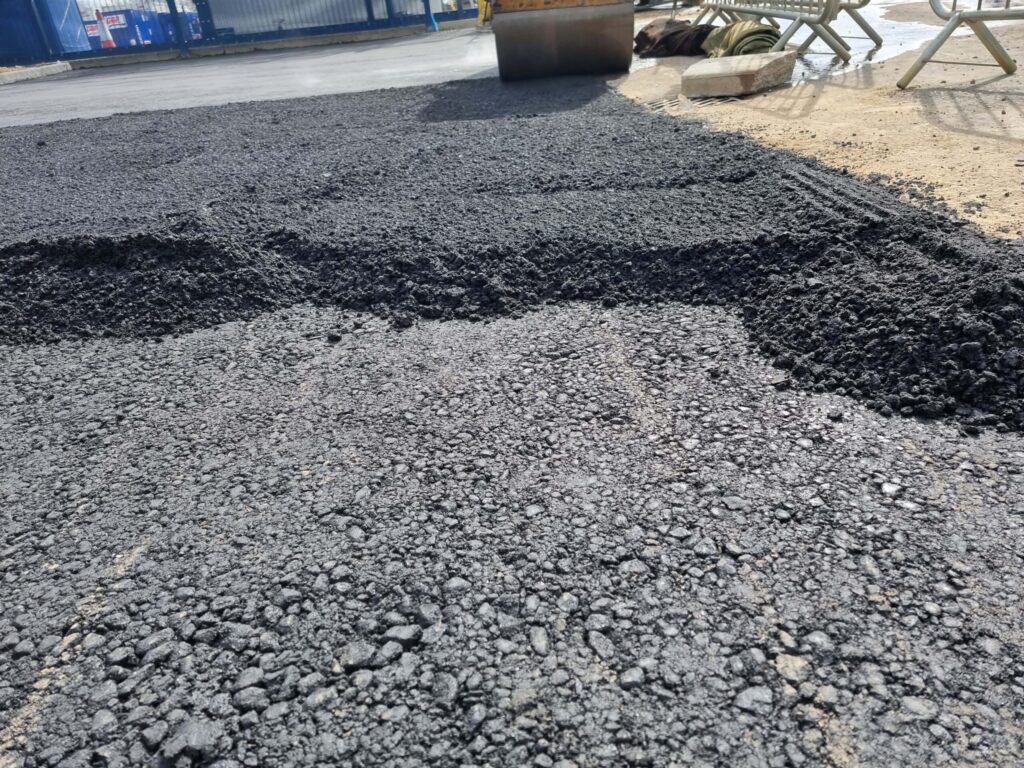
What Causes Potholes to Return After Tarmac Repairs?
A repaired pothole should restore a stable, even surface. When the same area breaks down again, it usually indicates that the repair did not fully address the cause of the original failure or that surrounding weaknesses have continued to develop.
Potholes rarely form because of the tarmac surface alone. Water ingress, inadequate support, poor drainage and repeated vehicle loading can all contribute. Understanding these factors is essential if a repair is expected to provide a dependable result.
Why Repaired Tarmac Potholes Can Reappear
A lasting repair must address the complete damaged area, including any unstable material beneath the visible hole. Filling only the surface depression may improve its appearance temporarily, but it cannot support the new tarmac if the foundation continues to move.
The Repair Only Covered the Surface Damage
A pothole often extends beyond the loose material visible from above. Cracks around its perimeter may indicate that the surrounding tarmac has already lost support or started to separate.
If new material is placed directly into the hole without removing the weakened edges, those edges may continue to crumble. The repair can then loosen at its perimeter and gradually break apart.
A more thorough repair normally involves cutting back to sound material and exposing the full extent of the affected section.
The Sub-Base Remains Unstable
Tarmac depends on a firm, well-compacted sub-base. If this supporting layer has softened, shifted or developed voids, the repaired surface may sink under repeated use.
Signs of possible sub-base failure include:
- The pothole returning in exactly the same position
- A depression forming around the repair
- Cracks spreading into the surrounding tarmac
- Movement under vehicle loads
- Several potholes developing close together
- Water collecting in the repaired area
The defective foundation may need to be removed and rebuilt before the surface is reinstated.
Water Is Still Entering the Repair
Water is one of the main contributors to recurring potholes. It can enter through cracks, poorly sealed joints, damaged edges or nearby drainage problems.
Once beneath the tarmac, water may weaken the supporting materials and carry fine particles away. Repeated vehicle movements then place additional pressure on the unsupported surface.
A repair should therefore consider where the water comes from and how it will leave the area. Filling the pothole without improving drainage may allow the same cycle to continue.
The Repair Edges Were Not Properly Prepared
The joint between the existing tarmac and the repair is a vulnerable part of the work. Loose fragments, dirt and moisture can prevent the new material from bonding effectively.
Repair edges should be:
- Cut back to sound tarmac
- Clearly defined rather than irregular
- Cleared of loose material
- Prepared to create an effective bond
- Properly sealed against water penetration
- Compacted evenly alongside the surrounding surface
If the joint opens, water can enter and traffic can begin breaking away the edges.
The New Material Was Not Compacted Sufficiently
Compaction gives tarmac its density and stability. Inadequately compacted material can contain spaces that allow water penetration and movement.
The repaired area may then:
- Settle below the surrounding surface
- Break up under turning vehicles
- Develop open-textured patches
- Separate at the edges
- Hold standing water
- Lose loose stones from the surface
Compaction must be consistent throughout the repair, including corners and edges where access can be more difficult.
The Repair Was Too Shallow
A shallow repair may fail when the deterioration extends deeper into the surface or foundation. Adding a thin layer of material cannot stabilise a pothole caused by failure beneath the tarmac.
The required depth depends on the condition of the surrounding surface and sub-base. Removing all defective material creates a firmer base for the replacement layers and prevents hidden weakness from remaining below the repair.
Drainage Problems Have Not Been Corrected
A repaired pothole may become a low point if the finished level does not follow the surrounding surface. Rainwater can then collect over the repair and enter through small imperfections.
The wider area should be checked for:
- Persistent puddles
- Blocked drainage channels
- Incorrect surface falls
- Water flowing towards the repair
- Saturated or unsupported edges
- Nearby depressions directing water into the damaged section
Correct levels and effective water management are as important as the repair material itself.
Repeated Vehicle Movements Are Concentrated in One Area
Potholes often develop where vehicles regularly brake, turn or follow the same wheel path. These movements can place greater stress on the surface than vehicles travelling straight across it.
The repair must be suitable for how the area is used. If the underlying construction cannot support the repeated loading, the new tarmac may deform or break down despite initially appearing sound.
Turning points, entrances and regular parking positions may require a wider assessment than the pothole alone.
The Surrounding Tarmac Is Also Deteriorating
Sometimes the repair itself is not the only problem. If the adjoining tarmac is cracked, brittle or beginning to lose aggregate, deterioration may spread back into the repaired section.
Warning signs include:
- Cracks extending away from the pothole
- Loose stones around the repair
- Several nearby depressions
- Edges breaking away
- Widespread surface fretting
- Earlier patches failing in different places
In these circumstances, a larger local reconstruction or resurfacing may be more appropriate than another small patch.
How Should a Returning Pothole Be Assessed?
Before carrying out further work, the affected area should be examined to establish:
- How deeply the damage extends
- Whether the sub-base remains firm
- Where water is entering
- Whether drainage is functioning correctly
- If the surrounding tarmac is still serviceable
- How vehicle movements affect the area
- Whether a local repair or broader solution is required
This helps ensure that the next repair addresses the mechanism of failure rather than simply filling the visible opening again.
What Makes a Tarmac Repair More Reliable?
A professional repair should remove all loose and unstable material, rebuild any weakened supporting layers and reinstate the surface with properly compacted tarmac. The edges should be carefully prepared and sealed, while the finished level should allow water to drain away.
The precise method depends on the depth and spread of the deterioration. A repair should therefore be designed around the condition of the site rather than treated as a standard filling exercise.
Conclusion
Potholes commonly return when unstable foundations, water ingress, poor edge preparation or inadequate compaction remain unresolved. Deteriorated surrounding tarmac and concentrated vehicle movements can also cause a repaired area to fail again.
Ely Driveways & Surfacing can assess recurring potholes in Ely, Cambridgeshire, identify the underlying cause and recommend a proportionate repair. If the same section of tarmac keeps breaking down, contact the team to arrange a professional assessment.
BLOG POST
Call us on: 01353 880 898
Click here to find out more about Ely Driveways & Surfacing
Click here to complete our contact form and see how we can help with your driveway needs.